The Open Hand in Karate-do — Teisho, Haishu, Shuto, Haito & Nagashi Uke
Technical guide to open-hand strikes and deflecting parries in Shotokai Karate-do: Teisho Uchi (palm heel), Haishu Uchi (back of hand), Shuto Uchi (knife-hand), Haito Uchi (ridge hand), and Nagashi Uke parries
The Open Hand • Striking Surfaces & Deflecting Parries
Shotokai Karate Budo • Technical Descriptions • Hand Techniques (Te Waza)
While the closed fist (Seiken) is the primary weapon introduced to beginners, the open hand possesses extraordinary versatility in traditional Karate-do.
Open-hand strikes can follow direct trajectories (such as Teisho) or circular arcs (such as Haishu). In classical nomenclature, these attacks are categorized under Uchi (indirect strikes)—referring primarily to the fact that the striking surface differs from the forefist knuckles rather than to the path described. When applied against vulnerable, soft anatomical zones, their stopping power is devastating.
Open-Hand Striking Weapons
1. Teisho Uchi • Palm-Heel Strike
Utilizes the dense, muscular heel of the open palm. The trajectory adapts flexibly to the target location: executed along the linear path of a Gyaku Zuki, it drives upward into the adversary's chin, nose, or lower ribs with bone-crushing force while keeping the fingers safely flexed backward.
2. Haishu Uchi • Back-of-the-Hand Strike
Follows a semicircular path similar to Uraken. Originating near the opposite ear, the arm and forearm extend outward, pivoting sharply around the elbow joint to strike with the flat back of the hand into the solar plexus, bridge of the nose, or ribs.
3. Shuto Uchi • Knife-Hand Strike
The classic sword-hand strike, impacting with the fleshy outer blade of the palm between the little finger and wrist. Executed with chopping, circular, or diagonal momentum, it targets the neck, collarbone, or ribs.
4. Haito Uchi • Ridge-Hand Strike
Uses the inner edge of the open hand, between the base of the index finger and the wrist, with the thumb tucked tightly beneath the palm. It travels in a wide, circular sweeping arc: as the arm extends, the palm rotates to finish facing downward, targeting delicate areas such as the temple, jawline, bridge of the nose, or carotid artery.
Nagashi Uke • Deflecting Flow Parries
Unlike hard, colliding blocks, these open-hand deflections operate on the principle of yielding and redirection: they never oppose incoming force head-on, but guide the strike harmlessly past its intended target, allowing the opponent's forward momentum to overextend their balance.
They are typically delivered simultaneously with an immediate counter-attack.
Te Nagashi Uke • Hand-Sweeping Parry
From a natural guard, open the hand and fold the elbow gently inward, drawing the open palm across the line of attack. Never flare the elbow outward or slap aggressively at the incoming arm; simply accompany and redirect the strike while the opposite hand strikes simultaneously.
Haiwan Nagashi Uke • Forearm Flow Parry
The forearm rises with the elbow outward in a motion resembling the initiation of Soto Uke. The wrist rotates smoothly outward, allowing the adversary's strike to slide effortlessly along the outside edge of the forearm and slip past the head.
Photographic Reference
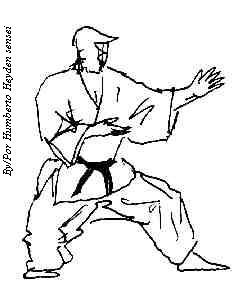 Shuto Uchi • Knife-Hand
