Master Tetsuji Murakami: What is the Origin of Shotokai?
A landmark historical interview extract with Master Tetsuji Murakami clarifying the distinction between Shotokan and Shotokai, Master Funakoshi's true non-tensed execution, and why sports tournaments distort authentic Karate-do
Archival Document • The Shotokai Encyclopedia Archive
The Origin of Shotokai: Liberation of Body and Spirit
Master Tetsuji Murakami was one of the pivotal pioneers who introduced Japanese Karate to Europe in the late 1950s. Initially trained in conventional rigid karate, his subsequent reunion with Master Shigeru Egami revolutionized his understanding of body mechanics, leading him to abandon sports competition completely in pursuit of true kinetic penetration and natural spiritual release.
The Interview
What is the true origin and historical meaning of the word "Shotokai"?
Before answering that question directly, I would like to clarify the origin and proper distinction of the terms.
Shotokai is the association behind Master Gichin Funakoshi’s method. "Kai" means association or school. In the 1930s, the senior disciples of Master Funakoshi established a fraternal association with the benevolent purpose of supporting the master, assisting his friends, and promoting the practice of his art.
The central dojo building that was constructed for him was named the Shotokan (kan meaning "building" or "house", named after Funakoshi’s poetic pseudonym Shoto). Master Funakoshi himself simply called his discipline Karate-do. However, the public quickly confused the physical building with the style itself, assuming that students coming from the Shotokan dojo were practicing a system called "Shotokan."
Shotokai is the historic body that possesses and restored both the central Shotokan Dojo and Master Funakoshi's family residence in Tokyo.
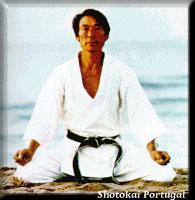
Master Tetsuji Murakami (1927–1987) • A dynamic exponent of the fluid, deep, non-contracted body dynamics taught by Master Shigeru Egami.
Why did Master Shigeru Egami choose a divergent path from the direction modern "Shotokan" was taking?
The chief instructor of Shotokai was Master Shigeru Egami. In the face of karate’s post-war evolution, and seeing that modern commercial "Shotokan" was straying further and further away from the authentic teachings of O-Sensei Gichin Funakoshi, Master Egami chose a decisively different stance.
When Master Funakoshi originally arrived in mainland Japan from Okinawa, he was already over fifty years old. His young university students frequently assumed that he executed his strikes and movements with such complete softness and relaxation solely because of his advanced age.
In reality, that relaxation was fundamental to true power. It is only in modern sport karate that everything has become dominated by tense muscular contraction and brute strength—and this represents a profound contradiction to authentic budo mechanics.
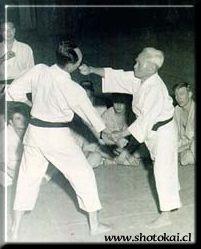
Master Gichin Funakoshi alongside senior disciples • Preserving the original essence of Karate-do beyond athletic modification.
How does tournament competition conflict with the etiquette and essence of traditional Karate-do?
Furthermore, the modern growth of sports competition stands directly opposed to Karate-do etiquette. Competition has caused the loss of what is most precious in Karate-do.
Perhaps we might not have had the moral right to criticize it if we had never known it—but we practiced it intensely, and having experienced it firsthand, we deliberately abandoned it! [Editor's note: Murakami Sensei originally taught and practiced sports competition before returning to Egami's pure Budo line].
Competition today is not the natural culmination of deep martial practice; rather, it has become practice tailored strictly for competition. That is something entirely different. Specialized athletic preparation is not pure martial practice.
In any case, comparing Shotokai with modern styles is simply not possible, because it is truly an entirely different realm. Its objective is never sports competition, but the liberation of body and spirit.
"Comparing Shotokai with other styles is simply not possible, because it is truly something completely different. It does not have tournament competition as its objective, rather the total liberation of body and spirit."
