Master Takashi Kyooka: Learn About Life (Opinions on Karate-do and Sports Karate)
A landmark interview with Master Takashi Kyooka (Chuo University, Tokyo) on the true nature of Keiko, overcoming muscular exhaustion to discover the will, his philosophical opposition to sports competition, and Egami Sensei's legendary spiritual training
Archival Document • The Shotokai Encyclopedia Archive
Learn About Life: The Spiritual Essence of Keiko and Budo
Master Takashi Kyooka began his karate practice at age 18 upon entering Tokyo’s renowned Chuo University. Immersing himself wholeheartedly into the school of Master Shigeru Egami and Master Gichin Funakoshi, he rapidly attained 5th Dan (Godan), the highest rank recognized in traditional Shotokai. In this direct dialogue, Kyooka Sensei articulates the true meaning of exhaustive physical practice, harmony in confrontation, and why Budo can never be reduced to a sport.
The Dialogue
How do you perceive the rapid spread and modernization of Karate across the Western world?
Today, Karate, like many other martial arts, has become very popular in Europe. Yet I must ascertain, with some sadness, that for the great majority of practitioners, the martial arts are either completely misunderstood or knowingly modified.
Many people now have a tendency to believe that Karate is simply a sport akin to boxing, tennis, or athletics. Tournament competitions have greatly contributed to this state of confusion, but I will return to that subject. My primary desire is to share with you the true concept of Karate—the view passed down directly from Egami Sensei.
Karate-do, like all authentic martial arts, is first and foremost a way to learn about life. In fact, Karate is life itself.
Why must traditional Shotokai training sessions be so exceptionally tough and demanding on the body?
Why do our training sessions need to be so rigorous? It is to "break" our body—to thoroughly exhaust and fatigue all that is muscular within it.
Once you have arrived at this point of total muscular depletion, you are forced to continue. It is at that precise threshold that Karate truly begins. Why? Because only your spirit—your pure will—can carry you forward past the point of physical exhaustion. Your will, alone, is capable of achieving a hundred times more than what muscle fibers can produce when bound by conscious fatigue.
Consider a simple analogy: How long do you think you could hang by your hands from a horizontal bar if your feet were only twenty centimeters from the floor? Perhaps fifteen minutes; perhaps half an hour. But imagine instead that beneath your feet lies an open abyss of five hundred meters of sheer drop, where slipping means certain death. How long would you hang then? Far longer, without question! Because it is no longer the physical arm or the isolated muscle sustaining you—it is your raw spirit, fighting for life.
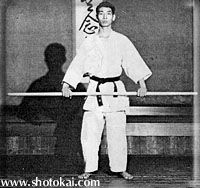
Master Takashi Kyooka in natural stance • Demonstrating relaxed poise and absolute concentration cultivated through Egami Sensei's teaching.
What is the true objective of Keiko (training), and how does one achieve harmony with an opponent in combat?
Keiko must be the school of the will. But equally, it is the school of harmony and of profound understanding between human beings.
How do we attain this? Through complete concentration and developing the capacity of anticipation (*sen*). This is why we place such heavy emphasis on "unlimited" fluid movements. In partner training—with one attacking and one defending—the defender does not focus on physical barriers; he concentrates totally upon the adversary's mind and intent. When the defender senses the attack at its inception, he naturally evades and counterattacks in a single breath.
To accomplish this, extraordinary concentration is essential: all mental faculties are fused with the adversary, while the physical body remains completely supple, relaxed, and devoid of tense contraction. Only the spirit resides in this hyper-alert, unbounded state. In real combat, the decisive factor required to prevail is to be in complete harmony with your adversary.
Through Keiko you learn authentic human relationships; you learn how to live alongside others and exist in harmony with nature. To advance along this path: always sink your hips lower (solid, low stances) and always strive to jump further and deeper.
What is your personal position on modern sports karate and tournament competition?
Personally, I am unequivocally against tournament competition. The reasons are very clear.
The first is philosophical: You must not practice martial arts to be the best among others, but to become a better person. What enduring value would I gain from knowing that I am "the best karateka in Japan"? None whatsoever. But on the contrary, knowing that today I can remain longer in Kiba-dachi (horse-riding stance) than I could yesterday proves to me that I have achieved a genuine victory over my own self of yesterday.
The second reason is technical and spiritual: In Europe and the United States, almost all practice has been redirected toward superficial competitive efficiency. The authentic philosophy of Budo has been entirely cast aside. Karate has been converted into a mere sport. I would have preferred that they had given it another name, because even fundamental techniques have been distorted—and in many commercial clubs, Kata has degenerated into nothing more than empty choreography.
You mention that Master Shigeru Egami taught "Spiritual Keiko" at Chuo University. What did that training entail?
Karate-do is a state of spirit, an entire philosophy of living. To touch this essence requires years of devoted practice. Here in Japan, at Chuo University, we practiced three hours every day under Master Egami’s personal guidance. He was our true teacher and judge, and he initiated us into what we call "Spiritual Keiko." This may sound extraordinary to modern ears:
In the first stage, we trained unyielding concentration. For three months consecutively, day after day, we would stand motionless for a full hour in kamae holding a heavy bokuto (solid wooden sword)—without shifting an inch, without blinking or closing our eyes. Only after that unbroken hour had elapsed would we execute a single cut, releasing in that one instant all the concentrated spiritual energy accumulated throughout the hour.
In the second stage, we ran four kilometers every day in under twenty minutes—and did so without breaking into perspiration, governed entirely by regulated respiration. Performing two kilometers of continuous usagitobi-geri (rabbit-hop leaping) was also part of this discipline.
Why this rigor? To temper our spirit, dismantle muscular tension, fortify unbreakable willpower, and align ourselves with natural breath. Never forget: all martial arts share one essential foundation—learning how to breathe. It is breath that gives us life, and through the authentic practice of Karate-do, we uncover that life in its purest form.
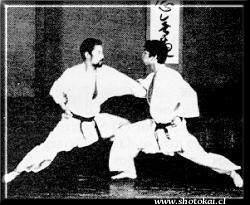
Shotokai masters and senior karateka in collective Keiko • Preservation of non-competitive, internal budo practice.
"You must not practice martial arts to be the best among others, but to become a better person. What benefit would I obtain knowing I am the best karateka in Japan? None whatsoever. But knowing I can stay longer in Kiba-dachi today than yesterday proves that I have won a victory over my self of yesterday."
