The True Sparring Partner of Yoshitaka Funakoshi & The Generational Reality
The Mejiro Shotokan laboratory, pre-war rigor, and distorted postwar claims
When Shigeru Egami entered Waseda University in 1931 and began training under Master Gichin Funakoshi, day-to-day instruction was being transformed by Funakoshi's brilliant third son, Gigo (Yoshitaka) Funakoshi (1906-1945). Yoshitaka was the technical dynamo of modern karate: he lowered stances, developed deep lunging attacks (oi-zuki), created new kicking techniques (mawashi-geri, yoko-geri kekomi, yoko-geri keage, and ushiro-geri), and formalized structured combat forms including Ten no Kata and Jiyu Kumite.
To test and refine these revolutionary methods, Yoshitaka needed an unyielding daily training partner (aite / 相手) capable of absorbing his terrifying impact and matching his speed. That partner was Shigeru Egami.
The Canonical Sparring Sequences: Egami & Yoshitaka in Action
During the Mejiro Shotokan era, Gigo (Yoshitaka) Funakoshi and Shigeru Egami systematically tested and photographed the combat forms that defined modern Japanese karate. These historic plates were published in Gichin Funakoshi's 1935 milestone Karate-do Kyohan.
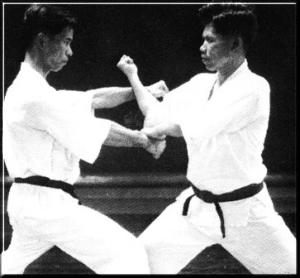
Daily Sparring at the Mejiro Shotokan: Gigo Funakoshi & Shigeru Egami
Master Gigo (Yoshitaka) Funakoshi (right) and Master Shigeru Egami (left) engaged in kumite, as published in Master Gichin Funakoshi's 1935 masterwork Karate-do Kyohan. Egami served as Yoshitaka's primary daily testing partner (aite), absorbing his ferocious strikes to refine the technical curriculum.
Shotokai.com Archival Collection • Tokyo, Japan
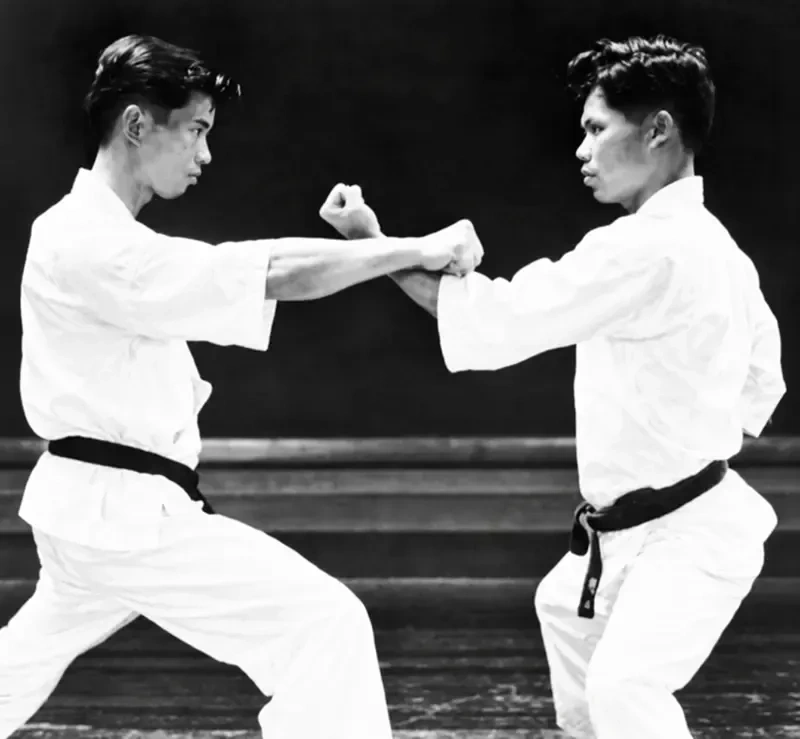
High Interception: Jodan Age-Uke vs Oi-Zuki
Shigeru Egami lunges forward with a decisive right high-level punch (oi-zuki). Yoshitaka Funakoshi steps back in deep zenkutsu-dachi, intercepting the attack with a sharp rising forearm block (jodan age-uke).
Karate-do Kyohan (1935) • Archival Plate
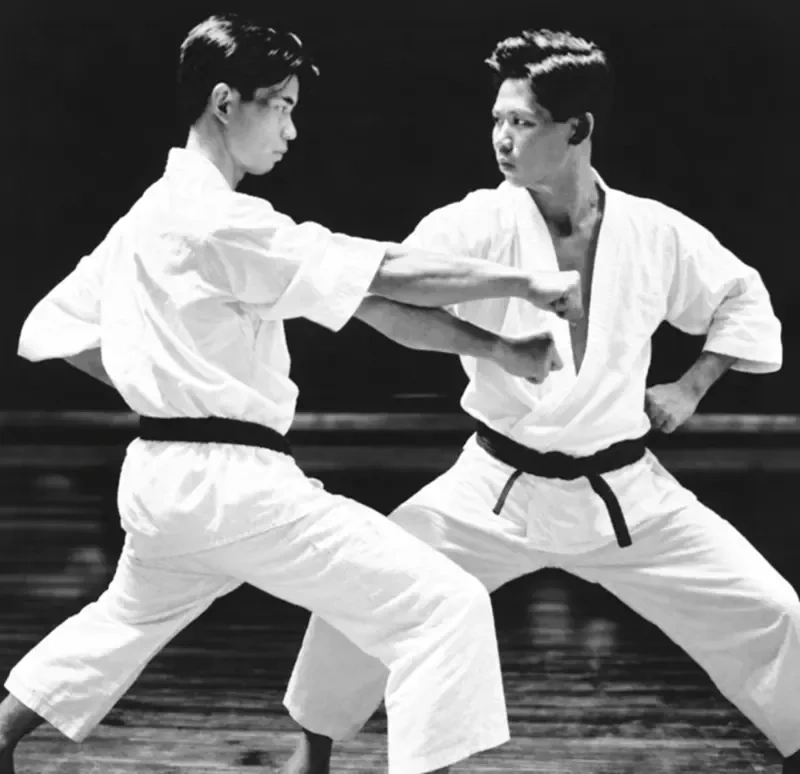
Low Sweeping Parry: Gedan Harai vs Chudan Tsuki
Yoshitaka launches a penetrating straight thrust with total commitment. Egami drops his hips and executes a downward sweeping deflection (gedan-harai), neutralizing the straight line of attack.
Karate-do Kyohan (1935) • Archival Plate
Middle Forearm Block: Chudan Soto-Uke vs Chudan Tsuki
Egami drives a middle punch straight forward. Yoshitaka rotates his torso into hanmi, catching and redirecting the incoming force with an outer forearm block while keeping his base firmly rooted.
Karate-do Kyohan (1935) • Archival Plate
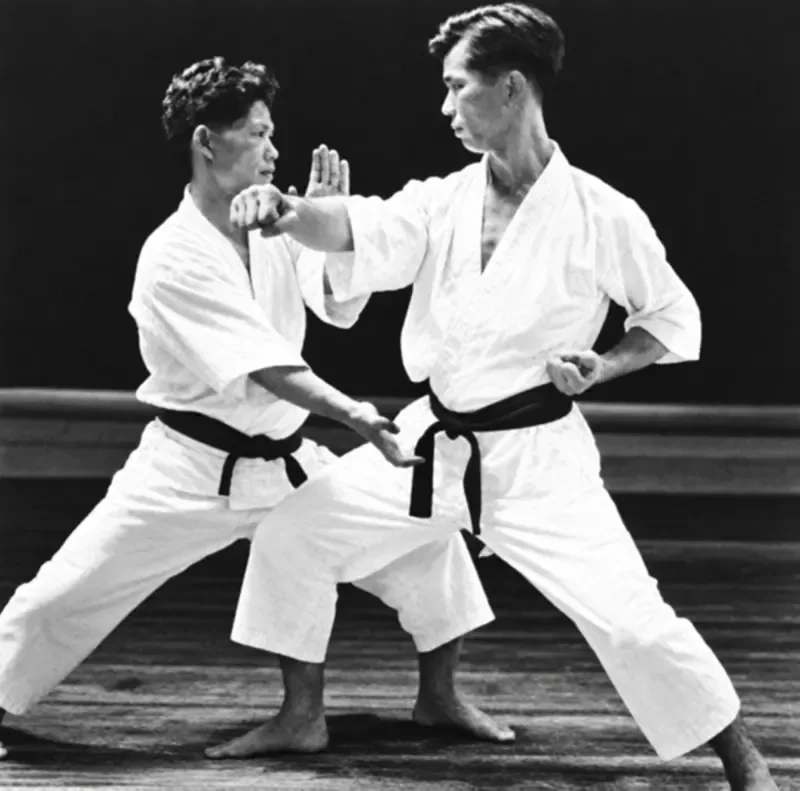
Knife-Hand Block: Shuto-Uke in Kokutsu-Dachi
Egami lunges in with determination. Yoshitaka transitions into a low back stance (kokutsu-dachi) and executes a razor-sharp knife-hand block (shuto-uke), deflecting the line while simultaneously preparing an open-hand counter.
Karate-do Kyohan (1935) • Archival Plate
Throughout the golden pre-war decade (1930-1940), Egami and his senior Genshin (Motonobu) Hironishi (born 1900) served as Yoshitaka's daily testing ground. Egami later recalled the raw force of Yoshitaka's blows, which routinely broke makiwara posts in two. In early photographs from Karate-do Kyohan (1935) and university archives, Egami and Yoshitaka stand facing each other in dynamic stances, demonstrating the newly developed combat curriculum.
Makiwara, Sandbag, and Stance Innovation
Historical photographs illustrating Master Yoshitaka Funakoshi's rigorous conditioning methods, deep structural stances, and rare personal archives alongside Master Shigeru Egami's youth training.
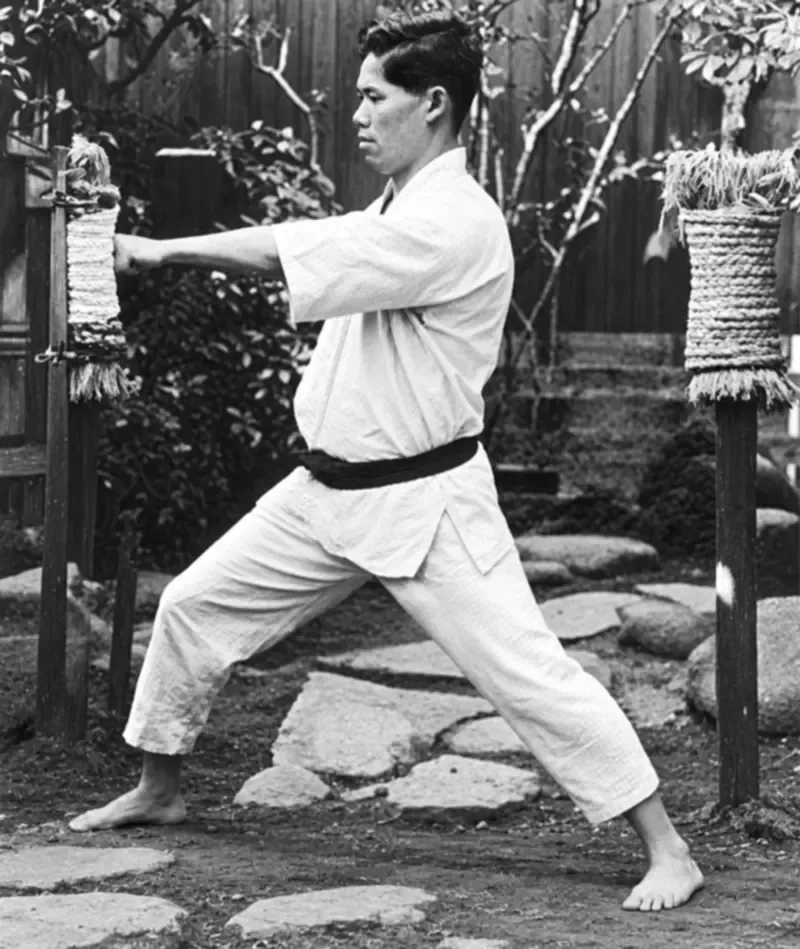
Outdoor Garden Makiwara Training
Master Yoshitaka striking the outdoor makiwara post in a deep zenkutsu-dachi. As Master Egami recorded, Yoshitaka threw his full bodyweight into each impact, frequently breaking the heavy posts in two.
Historical Archival Plate • Tokyo
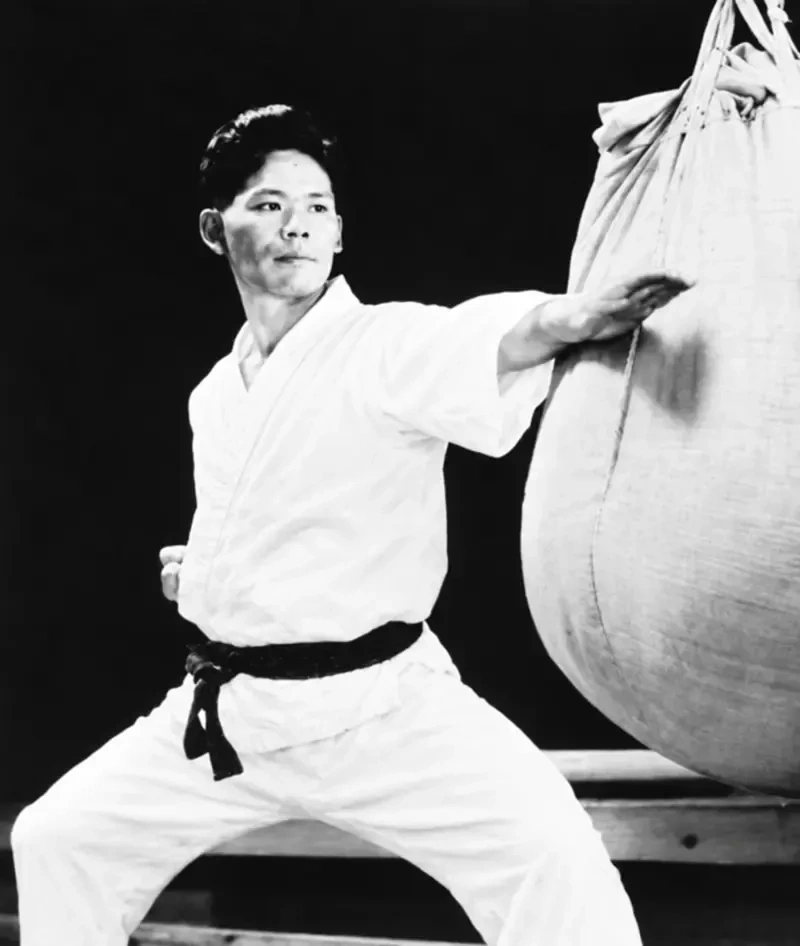
Heavy Sandbag Strike (Shuto)
Yoshitaka delivering a knife-hand blow (shuto-uchi) from a grounded horse stance (kiba-dachi) against a suspended heavy canvas sandbag, developing dense bone conditioning and penetration.
Historical Archival Plate • Tokyo
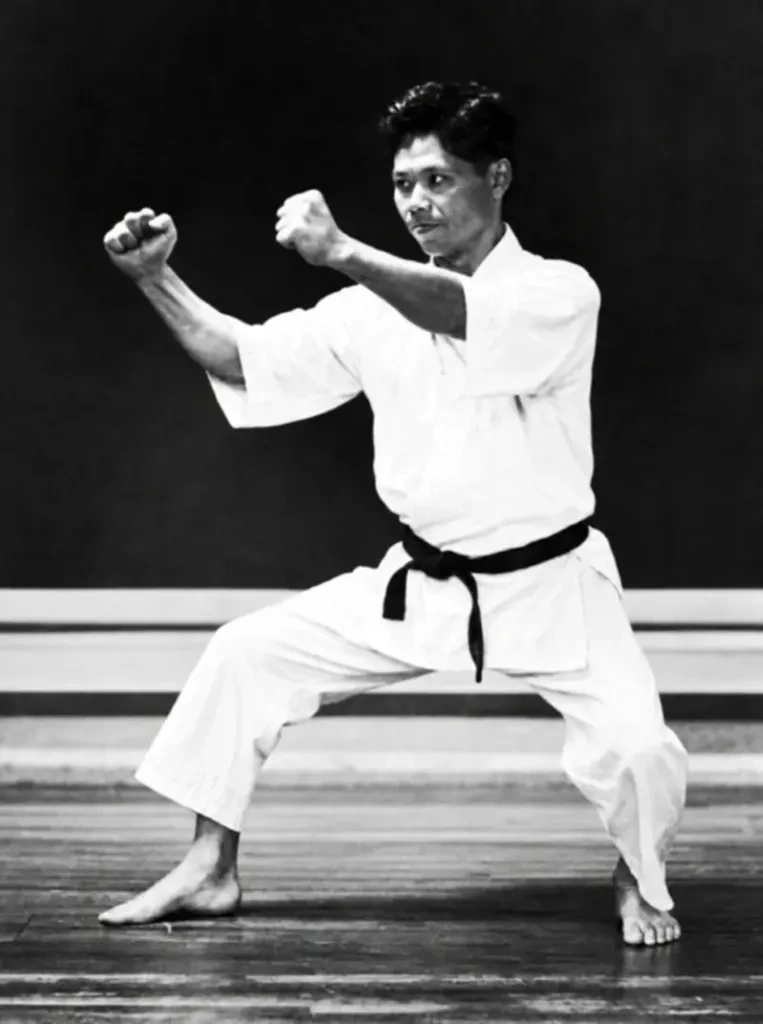
Full-Body Kiba-Dachi Guard
Iconic full-length study of Master Yoshitaka Funakoshi demonstrating the deep, wide horse stance that served as the primary physical laboratory for leg strength and hip connection.
Historical Archival Plate • Tokyo
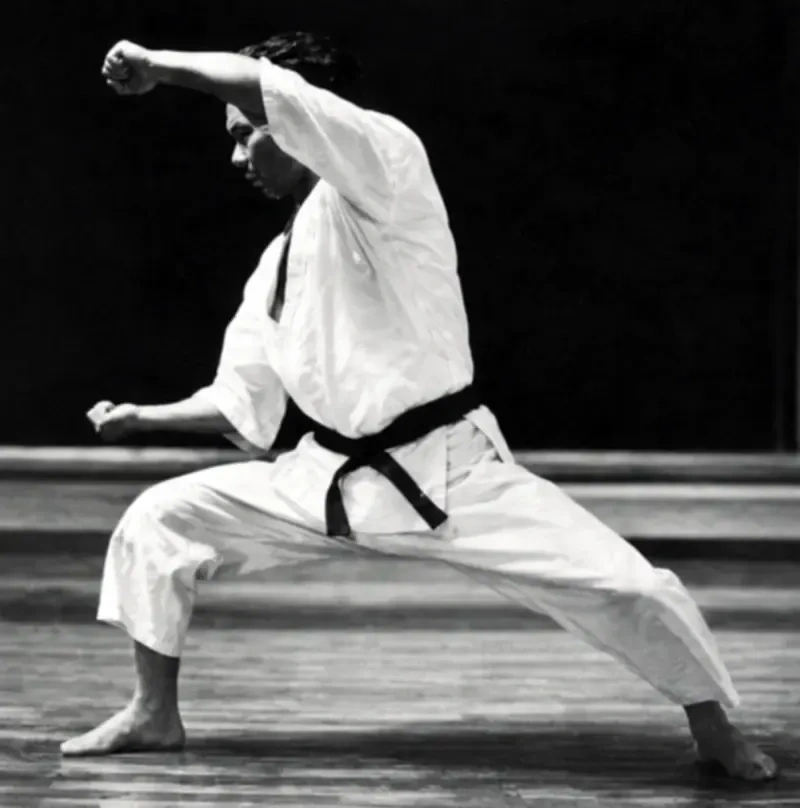
Deep Lateral Stance Mechanics
Master Yoshitaka demonstrating the low center of gravity and expansive width that allowed karateka to generate explosive springing momentum over long distances.
Historical Archival Plate • Tokyo
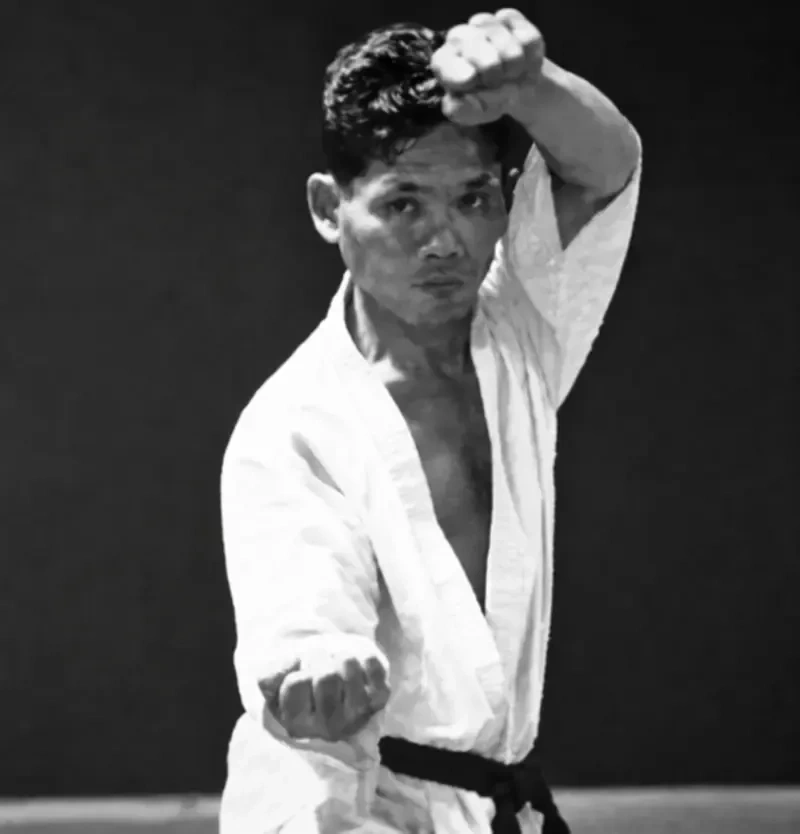
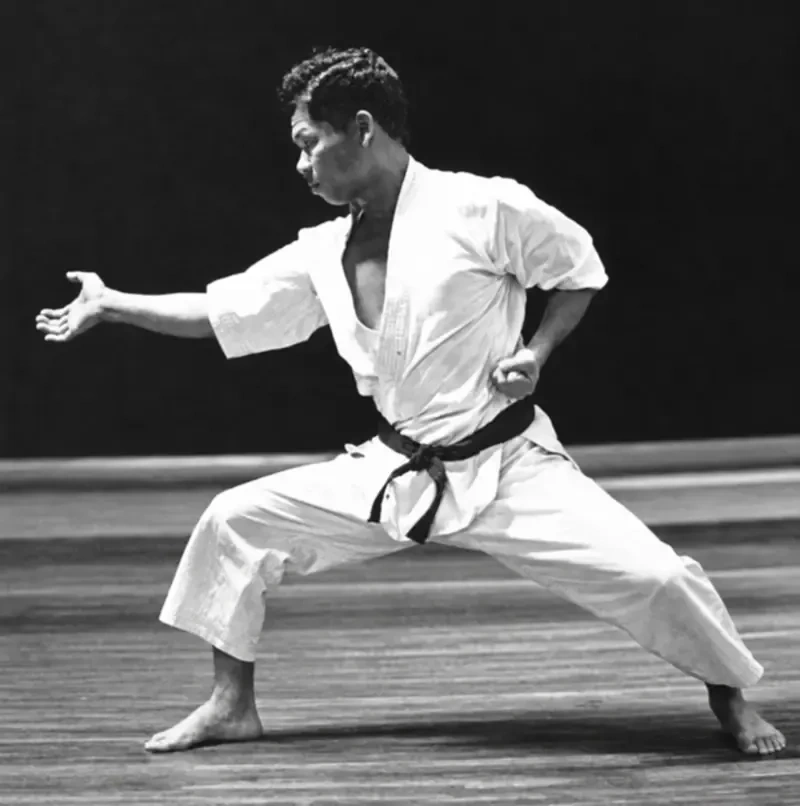
Upper Deflection Dynamics (Age-Uke)
Upper-body action plate highlighting the upward deflection line (jodan age-uke), maintaining upright spinal alignment and focused visual intention.
Historical Archival Plate • Tokyo
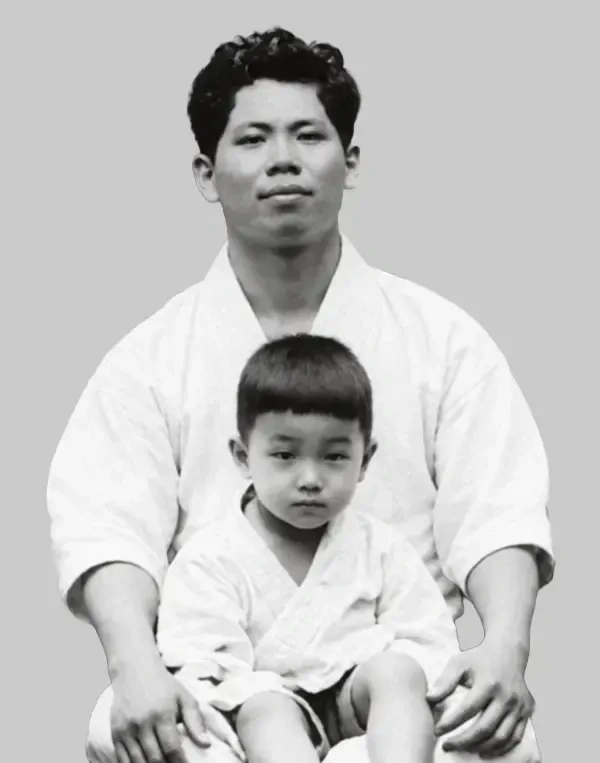
Rare Portrait: Yoshitaka with Child
The complete, uncropped archival print of Master Yoshitaka Funakoshi seated in dogi with a young child in dogi on his lap. The iconic headshot portrait circulated worldwide was originally cropped from this intimate photograph.
Shotokai.com Archival Collection • Tokyo
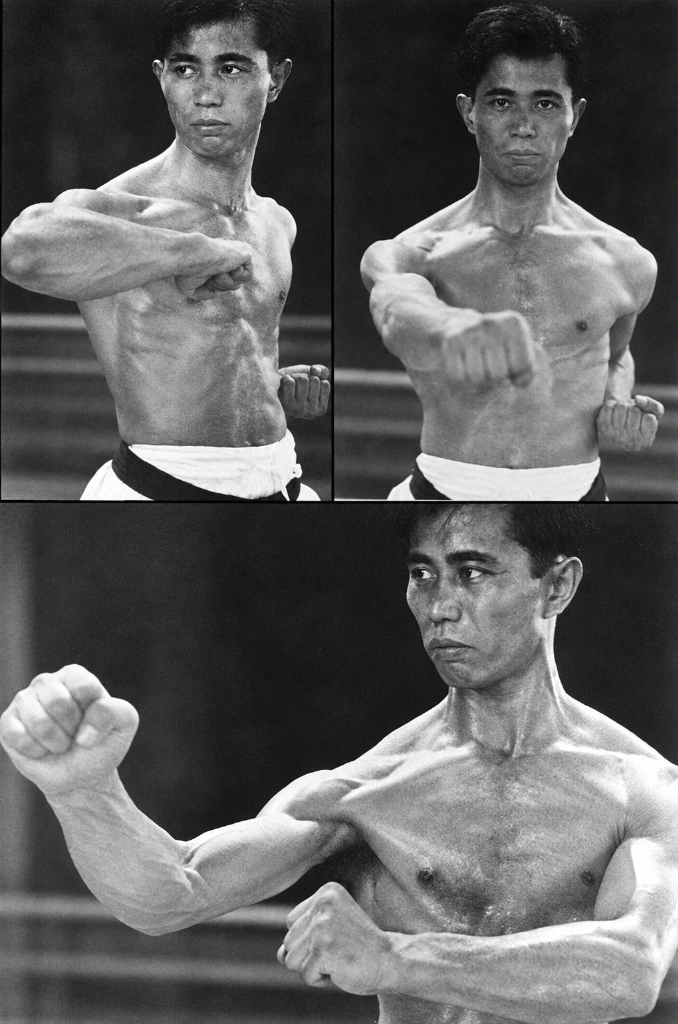
Shigeru Egami in His Youth: Rigor and Conditioning
Archival three-photo montage preserved by Nihon Karate-do Shotokai (shotokai.jp) showing Master Shigeru Egami in his twenties, during the height of his relentless training with Yoshitaka. Note the intense muscular conditioning, deep rooted stances, and focused kime before his postwar illness and subsequent spiritual breakthroughs into natural relaxation.
Courtesy of Shotokai.jp (NKS) Archives • Tokyo (c. 1930s)
The Generational Reality and Postwar Claims
Yoshitaka Funakoshi died tragically young on November 24, 1945, at only 39 years of age, succumbing to tuberculosis after the Mejiro Shotokan dojo was incinerated in an Allied air raid in April 1945.
In the postwar decades, as karate expanded across Europe and the Americas, several instructors attempted to claim direct lineage or sparring partnership with Yoshitaka, seeking to bolster their personal prestige ("bringing water to their own mill"). Prominently in Europe, Sensei Taiji Kase (born February 9, 1929) was frequently depicted by followers as Yoshitaka's direct partner and senior disciple.
A calm examination of the historical chronology clarifies the reality:
- The Pre-War Decade: When Yoshitaka and Egami were revolutionizing karate and publishing Karate-do Kyohan in 1935, Kase was barely six years old.
- The Wartime Reality: When Kase began university karate at Senshu University around 1944-1945, he was only 15 to 16 years old. By that time, Tokyo was under severe bombardment, the central dojo was destroyed, and Yoshitaka was already bedridden and coughing blood in the terminal stage of tuberculosis.
- The Age Bracket: Practitioners of that younger cohort were simply not old enough to have had Yoshitaka as their active senior (sempai), let alone to have served as his regular sparring partner.
The historical record is clear: the only figures who stood before Yoshitaka Funakoshi's punches day after day, and who developed the modern technical canon alongside him, were the pre-war seniors: Shigeru Egami and Genshin Hironishi.
