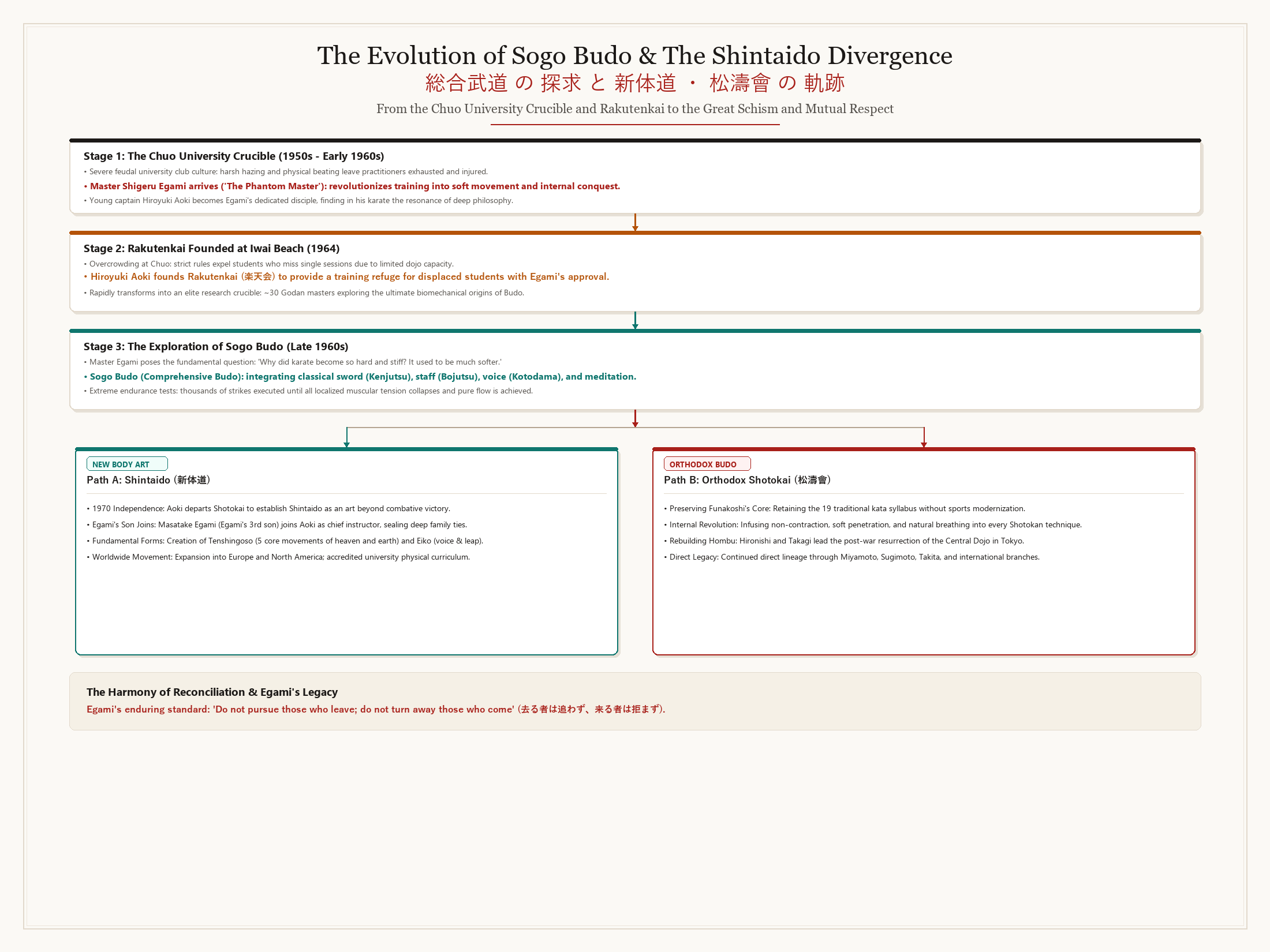
Stage 1: The Chuo University Crucible (1950s - Early 1960s)
In postwar Japan, university martial arts clubs were dominated by severe feudal hierarchies: harsh hazing rituals, physical beating, and rigid discipline. Practitioners routinely suffered chronic exhaustion and debilitating injuries.
Into this intense crucible arrived Master Shigeru Egami, whom students nicknamed "The Phantom Master" due to his gaunt frame and silent footwork. Despite having survived major surgeries removing nearly his entire stomach, Egami bewildered the university athletes: his blows did not push or bruise the surface, but penetrated instantly without localized muscular clenching.
Young club captain Hiroyuki Aoki found in Egami "a beam of sunlight in darkness," dedicating himself completely to understanding this soft internal power.
Stage 2: Rakutenkai Founded at Iwai Beach (1964)
Faced with overcrowding at Chuo and unforgiving club regulations that expelled members who missed a single session, dozens of passionate practitioners were cast out. With Egami's enthusiastic blessing, Hiroyuki Aoki established Rakutenkai (楽天会) at Iwai Beach (Chiba Prefecture) in the summer of 1964.
Rakutenkai was not conceived as a breakaway sect, but as an elite research laboratory. Approximately thirty Godan (5th Dan) black belts gathered to explore the ultimate physiological boundaries of human movement and the biomechanical roots of Budo.
Stage 3: The Exploration of Sōgō Budō (Late 1960s)
Master Egami presented Aoki with the fundamental historical question: "Why did karate become so hard and stiff? It used to be much softer."
To answer this riddle, the research group developed Sōgō Budō (Holistic / Comprehensive Martial Art), integrating diverse classical systems:
- Kenjutsu (Classical Swordsmanship): Releasing shoulder tension and matching spatial distance (Maai).
- Bojutsu (Long Staff): Harnessing hip rotation and downward gravitational weight.
- Kotodama (Voice Projection): Using guttural vocal resonance to dissolve psychological inhibition and free the diaphragm.
- Extreme Endurance Trials: Thousands of consecutive repetitions executed until all superficial muscular tension collapsed into pure, uninhibited flow.
Shintaidō (新体道)
Around 1970, Hiroyuki Aoki announced the independence of Shintaido (New Body Way), departing from combative karate to create an expansive, non-adversarial body movement art dedicated to universal harmony.
- Egami's Son Joins: Masatake Egami (Egami's third son) joined as chief instructor, sealing an indelible filial bond between the traditions.
- Foundational Kata: Creation of Tenshingōkō (five core movements of heaven and earth) and the expansive leap Eiko.
- Global Spread: Flourishing national federations across Europe, North America, and Japan.
Orthodox Shotokai (松濤會)
Concurrently, the main body of students led by Genshin Hironishi and Jotaro Takagi preserved the classical karate syllabus founded by Gichin Funakoshi.
- The 19 Traditional Kata: Preserving the classical Okinawan curriculum free from competitive sporting degradation.
- Internal Revolution: Infusing the principles of non-contraction, soft penetration, and natural breathing into every technique.
- Hombu Dojo Rebuilt: Re-establishing the Central Dojo in Tokyo (1976 and 1995), stewarded by Miyamoto, Sugimoto, and Takita.
The Harmony of Reconciliation: Egami's Enduring Standard
In Japanese martial history, institutional schisms almost invariably produced bitter recriminations, lifelong enmities, and formal expulsions. Master Shigeru Egami reacted with serene generosity:
"Do not pursue those who leave; do not turn away those who come."
去る者は追わず、来る者は拒まず (Saru mono wa owazu, kuru mono wa kobamazu)
When practitioners drifted back from Shintaido to Shotokai, Egami welcomed them without reproach. He shared tea brewed by Chiyoko, encouraged their discoveries, and maintained unbroken personal affection for Hiroyuki Aoki and his son Masatake until his death in 1981.
