Meeting Master Shigeru Egami
Hiroyuki Aoki Sensei recounts his severe university karate training, the sudden arrival of Master Shigeru Egami - the 'phantom master' - and how Egami transformed karate practice from rigid feudalism into a luminous path of non-contraction, natural softness, and spiritual awakening
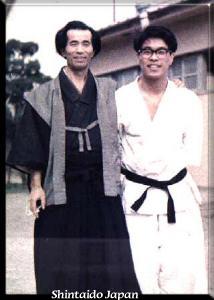
Archival Document • The Shotokai Encyclopedia Archive
Memoir: Meeting Master Shigeru Egami
Editorial Note from The Shotokai Encyclopedia (not included in the book):
First of all we clearly recommend you try to buy this book; it includes information not only interesting to Shintaido participants but for any person in the martial arts. Furthermore, the description of Shintaido's foundations and basics are very compelling.
Hiroyuki Aoki, as the text recounts, was one of Master Egami's most important students. When Master Egami founded the Rakutenkai - a select research group of 30 Shotokai 5th Dan (godan) masters and specialists in various classical Japanese arts with the objective of researching the arts - Mr. Aoki was chosen to guide the group. Through this group Mr. Egami fostered the idea of Sogo-Budo or Holistic Martial Art.
Once the foundations of a new martial art were established, Master Egami was not able to take off as its founder due to his profound responsibility in Shotokai. Today Master Aoki, the founder of Shintaido, is the director of the International Shintaido Federation.
1. Severe University Beginnings: Survival in the Feudal Dojo
...After I started practicing karate, I was very surprised. My honorable sempai or "seniors" trained me in a crazy, inexplicable way.
The group captain or leader in each generation before me had been a man of high character, and most of the senior members were the same age or younger than I, so I wanted to survive the severe training and live up to their expectations.
Often my body would be covered with welts, there would be blood in my urine and I would have to crawl on all fours to the bathroom at night.
This type of training is almost impossible to envision in today's more democratic, moral circumstances. It would have been unnecessary at the time, also, if more effective methods had been available to us.
2. The Arrival of the "Phantom Master"
In the autumn of my second year, about one and a half years after I joined the karate club, Mr. Shigeru Egami, called the "phantom master", appeared in Tokyo after spending many years in the country.
We asked him to teach us as a special instructor. At the same time, I became captain of the Chuo University Karate Club and started to lead classes.
3. A Beam of Sunlight Piercing the Darkness: Competition Within Oneself
Egami's teaching was like bright sunshine penetrating the darkness.
He had been a great student under Gichin Funakoshi, the founder of modern Karate-do and the first master to bring Karate from Okinawa to Japan. Mr. Funakoshi had told his students that in Karate there are no title matches which would restrict them with rigid rules.
Mr. Egami developed this idea by teaching us that the practice of Karate involves competition within oneself. He taught us that if there is an enemy, it is our self.
He completely changed the traditional and feudalistic conception of our practice. In addition, his training was quite gentle and strangely soft; he never allowed a sadistic or oppressive feeling to enter our practice.
Through his teaching, Karate movement suddenly approached the basic thinking of the artists and philosophers I had always admired in Japan and abroad. He introduced the stream of ki energy and a soft natural movement - unknown in the usual Karate world.
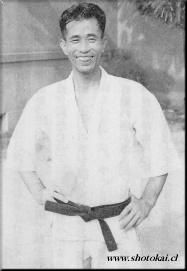
4. "Why Did Karate Become So Hard and Stiff?" - The Quest for Modern Heiho
When we started our Karate Club practice under Mr. Egami, he would often say:
"Why did Karate become so hard and stiff? It used to be much softer."
He used to say we should always seek softer movements which would be good even for sick and old people.
His constant aim was the creation of a modern way of heiho ("a means of training in the day-to-day world") by arranging the rough and simple fighting methods of the South China Sea area.
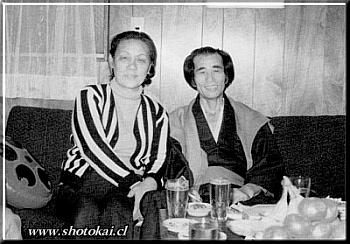
5. Universal Principles of Genuine Bodily Movement
Mr. Egami's teaching is an invaluable guide for anyone seeking a genuine martial art. He taught us:
- To eliminate tension as much as possible through deepening concentration and proper meditation.
- To use holistic or integral power, rather than strength originating from one part of the body.
- To develop soft and natural movement with no surplus tension in the shoulders.
These are the most basic tenets, not just for Karate, but for all body movements.
6. The Foundation of Shintaido
Shintaido does not diverge from this theory and I do not believe that it should.
To be natural and move as we want is sufficient.
