Facing Yourself: The Ultimate Test
A gripping profile of Tom Muzila (4th Dan under Tsutomu Ohshima) on facing death on Mt. Whitney, breaking past artificial personal limits through 24-hour training, and the samurai ethic of cutting oneself
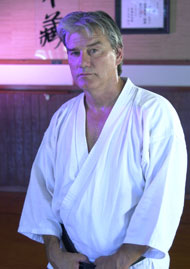
Tom Muzila • Shotokan Karate of America (SKA)
Facing Yourself: The Ultimate Test
"A samurai wears two swords. One to cut the enemy and, more importantly, one to cut himself." Carrying this feudal principle to its modern edge, Tom Muzila demonstrates that human limits are almost entirely self-imposed illusions, and that true martial budo is a direct path to spiritual awakening.
1. The Frozen Ledge on Mt. Whitney: Facing Death on Ice
"It was a clear, warm day in November, and I was in good shape, so I decided to see if I could break the record for climbing Mt. Whitney. Whitney is the highest mountain in the continental United States outside of Alaska. The fastest anybody had ever climbed it was in about four hours, four hours and ten minutes. But I had climbed that mountain quite a few times, and I thought I might be able to break the record.
"I just wore jogging shoes and a sweatsuit, clicked my stopwatch, and started climbing. As long as the weather held out I was doing really well. But I only had a couple thousand feet to go (the mountain is nearly 15,000 feet high) and about an hour left to do it in, when a cloud mass started moving in over the top of the mountain range.
"As soon as the sun was gone, all the melting snow and water froze up again immediately. I was not dressed for cold weather, and at that altitude, it could have been a blizzard blowing in, so I decided I had to turn back.
"The problem was that some of the places I had crossed easily on the way up were frozen. At one spot I had to crawl quite a ways along a narrow ledge, and then suddenly I came to a part of the ledge about 12 feet long that had turned into a solid sheet of ice, like a frozen waterfall. The temperature was dropping pretty far below freezing; with the wind chill factor it must have been around minus 30 or 40 degrees.
"My only chance to get across was a sharp piece of rock jutting out through the ice about seven feet away from me. If I could jump out there and catch this rock, I would be able to swing my legs over beyond the ice. If I missed, or if the rock broke, I would go sliding down a sheer ice track for several thousand feet.
"That was a moment when I really had to face myself, let go of all my mental blocks and insecurities, even the fear of death, and just act."
2. Eliminating the "What Ifs" and Artificial Limits
According to Tom Muzila, the man who spoke these words, that moment hanging on the ledge on the way down Mt. Whitney was one of the truest it is possible for a human being to experience. The state of mind which he felt there is also the reason he has trained for the past 15 years in Shotokan karate, achieving a Yodan (fourth-degree black belt) in the famed Shotokan Karate of America organization, under Tsutomu Ohshima.
"When you are in a situation like that, actually facing death," Muzila says, "you get rid of all the distractions, all the little, petty thoughts, all the garbage in your mind. If I had started thinking: 'I am going to die, what if the rock breaks, what if I slip, what if I do not make it', there is no way I could have made it with all those 'what ifs.' But if I forget about all that, forget about whether I am going to fall or not, and just do it, then I have a chance.
"The thing people do not realize," he continues, "is that they set their own limits. People stop themselves from most of what they can really achieve."
For Muzila, a chief motive for the dangerous, exhilarating sport of mountain climbing is the desire to push beyond limits, to break down barriers within him that most people never find or question within themselves. He practices - and recommends that others practice - karate with the same end in view.
3. Beyond the 1,000 Cliché: 10,000, 50,000, and 24-Hour Practice
A common convention in nearly every traditional martial arts organization, including Muzila's own SKA, is the number 1,000. As Muzila explains:
"So often in Special Training, we do 1,000 of each of the basic techniques; and in our own practice too, whenever we do a lot of some technique, we do 1,000. At first of course it was really hard, but after a while it seemed to me we were getting too attached to that number. Each technique takes a couple of seconds, so 1,000 repetitions take about half an hour. It was becoming a defined quantity, a comfort limit.
"So I picked a new number: 10,000. It was almost like saying a million. You could not conceive how long it might take; the mental state you had to start with was that you were going to do this forever, for the rest of your life. You just had to let all your mental blocks go and accept that you were here, doing this technique, forever.
"And then, after doing that a few times, even that started seeming like a limitation. It began getting easier, more finite, so I set a new number: 50,000. And then I decided just to do a regular practice, but to go straight through for 24 hours. Every time I did something like this, it was not intended as some kind of stunt; the idea was to keep pushing beyond my mental barriers in karate."
It is important to remember that the real test of these long, enduring practices was not endurance, but concentration. Muzila is the first to warn that combat is not like marathon running.
"In the martial arts there is no time," he says. "You face the opponent, and everything is there all at once. It can all be over in a split second."
He cautions that it would be wrong, even counterproductive, to practice the same technique for hours on end in some kind of euphoric trance, with each particular technique being just another tick of the clock on the way to 24 hours or 50,000 repetitions. Every single technique has to be your best, like the last one before you die. You do those 10,000 or 50,000 so that you can do one that is really your best.
4. The Psychology of Elevation, Exhaustion, and Deep Will
"People think: 'Oh, I could not do that', or 'Me? Run 30 miles? Oh, I could never do that.' But they do not have any idea of their real limits because they have never pushed themselves. Most people have never even tested themselves to see how long they can go without food or sleep. So they set artificial limits. They are afraid of things that really would not defeat them. They are ruled by fear, and their entire lives are inhibited that way."
During every intense effort, the ultimate challenge is always present, right at hand: the interior voice that makes excuses, that gives up, that tries to convince you of the folly of your project long before you have really been defeated. Facing that challenge is what Muzila refers to as "facing yourself."
"Aside from the cold, the exhaustion, the danger, there is also the sheer elevation to deal with in climbing a mountain," he explains. "After a certain height your brain is not receiving enough oxygen, and your body starts losing energy. It is like not having slept in several days: you start seeing weird phantom images out of the corner of your eye; your senses get disjointed, they come in little bits and pieces. That is the hardest thing about climbing. Even to do little things is a major project. To heat up some water is like making a gourmet dish up there... just to think about it: 'Let us see, did I turn on the stove first? Water in the pan?'
"And then to function under those conditions. You really have to push. Every step you take, you do not even worry about the top of the mountain, or getting down, or anything. It is just this step, umphh! and the next one, hmmh! And you have to use all your will, all your energy, beyond the conscious mind; your deepest will has to focus. You have no oxygen, little food, no energy. You cannot depend on muscular energy to do it; you have to depend on breathing, mentality, will - a deeper energy - to pull you through."
In a similar way, Muzila's 24-hour practice sessions help the practitioner break through to a whole new level of mental and physical performance:
"At first, you are putting everything into each technique, but there is an excess of power, a wastage of power. Then, the more tired you get physically, the more you have to force yourself through every repetition, the more economical your movement gets. Your breathing adjusts itself, your shoulders relax, your mind clears itself of extraneous thoughts, and you are just there, doing the practice. You get rid of all excess power, all purely physical power, and what you are developing is a strong mentality."
"A samurai wears two swords. One to cut the enemy and, more importantly, one to cut himself."
5. The Value of One's Word: Bandaged Feet and Feudal Honor
Muzila did succeed in his desperate leap over the ice on Mt. Whitney. He managed to hobble down the rest of the mountain and made his way to a local tavern in Lone Pine, the village at the base of the range.
There he found that the skin of both his feet had turned a transparent gray-white, underlain by patches of deep, frozen black - a severe case of advanced frostbite. The danger of dying on Mt. Whitney was behind him; the immediate danger of having one or both his legs amputated had just arisen.
Nevertheless - and here is perhaps the most difficult part of the story for modern people to comprehend - Muzila had given his word about something a few days earlier. He had promised to participate in a martial arts demonstration for a friend, playing the role of the villain who gets soundly defeated.
Although he could barely stand, he was determined not to break his commitment on such short notice. He taped his feet with bandages the next morning, did not mention a word of his catastrophe to anyone, endured the agony of performing the fight scene with his friend, and only then went to the hospital.
And the lesson Muzila draws from that ordeal?
"I had given Kenny my word, and I did not want to break it. You know, your word is the most important thing you have."
Fortunately, a frostbite specialist was able, over a period of weeks, to save the limbs. To those who do not feel bound by their word, the episode might seem reckless. But Muzila argues: how can a person who is afraid of pain, afraid of death, afraid of a hundred petty things, ever make an authentic moral choice about anything in life? It is necessary to conquer oneself in order to see reality clearly. Otherwise, one simply cannot see past one's own subjective insecurities, fears, and the web of excuses they conjure up.
6. The Crucible of Kiba Dachi: The Story of Mark Kohagura
In martial arts, facing oneself makes nearly any student a much stronger fighter.
"In our Special Training practices," Muzila explains, "we do an exercise where we stand in kiba dachi (horse stance) for an hour and a half. You can see right there who has a strong mentality. Because, especially the newer members, will start rising up slowly after just a few minutes. Doing that stance at the proper height, the right way, your legs feel like they are on fire, or have knives stabbing into the muscles. And the mind will want to make excuses.
"First, you start thinking: 'Why did I come here? I could be at the beach, or almost anywhere but here.' Then, the mind comes up with: 'Okay, I will do it, but I am not going to push hard; I will just get through this', and so you start rising up when none of the seniors are looking. To keep yourself down at the proper level takes an iron mind. You have to keep on yourself literally every second. And after you do it, you find that in life you can push yourself just a little bit more in anything you do. In martial arts, you can face much stronger opponents after completing an exercise like that.
"One of our members, Mark Kohagura, was a perfect example. He went to Special Training twice that year, once on the East Coast and right afterward on the West Coast. He was young, maybe 21 years old, and he stood in the stance just right, knees very low. In the second Special Training, he passed out from the sheer effort about five or ten minutes before the end.
"And after that, he was a completely different fighter - his kumite changed entirely. Even before that, he was probably one of the strongest jyu-kumite (free-sparring) fighters in the country, winning our Nisei Week tournament four times. But he had not been performing up to his true highest potential.
"After that ordeal, when he faced an opponent, he would immediately take control. He would move right in with the winning attack - move in, and he already had it. He would take kamae, the opponent would twitch, and Bam! he caught him. His spirit penetrated completely. In the kiba dachi exercise, you have to generate that kind of spirit just to keep yourself down."
7. The Role of the Senior (Sempai) as a True Mirror
If a student cannot do it on their own, the martial arts provide an invaluable structure for facing oneself: the senior / junior (sempai / kohai) relationship.
Lower-ranking students enter the dojo and do not know what to expect. All they know is that their senior will demand their absolute utmost - and that, in turn, the senior will never ask them to do something he himself is not willing to do.
"Left to himself, the junior student will always look for the easy way out," Muzila explains. "He will raise himself up out of a horse stance, so the senior has to come over and catch him. Or somebody may sincerely think he is doing something right - maybe he is in a euphoric trance, punching without real focus but imagining he is giving his all. A senior walks over and shouts: 'Hey! What is the matter with you? What do you think you are doing?' And immediately the practitioner snaps awake and goes back to punching the right way."
In the martial arts, the senior is an external mirror to help you face yourself, because a worthy senior will never be satisfied until he sees you doing your absolute best.
8. The Direct Mountain Path of Karate-do
And the martial arts have one further advantage: pain.
Because realistic combat is central to training, every student has the strongest possible incentive to learn quickly. The slower you learn, the longer you get hurt.
"One of the main advantages of martial arts is that you have to face pain. You almost have to understand everything, all at once. Just like climbing a mountain, there is always more than one way to go up. You can make climbing Mt. Whitney an all-day casual hike, bring a picnic lunch, take the easy trails at the mildest time of year. Or you can make it a fierce, uncompromising discipline.
"Martial art is a path up the same mountain as many other spiritual paths. But it is a very straight path, straight up. You can reach the peak in one day - but you can also perish."
The essential task is to keep striving to awaken:
"The difference between the waking person and the person who is asleep is that the sleepwalker feels he is already awake; the awakened one is still striving, pushing, struggling to be awakened."
