Tom Muzila: Training in the Bushido Spirit (The Marathon Approach)
A landmark interview with Tom Muzila (4th Dan under Tsutomu Ohshima) on the marathon approach to karate, breaking mental barriers through 10,000 repetitions, conquering fear, and samurai endurance
Archival Document • The Shotokai Encyclopedia Archive
Training in the Bushido Spirit: Tom Muzila's Marathon Approach
In 1686, samurai archer Wada Daihachi shot 8,133 arrows across the 128-yard veranda of Kyoto’s Sanjusangendo Temple in an unbroken 24-hour vigil. Carrying that same relentless feudal ethic into modern karate, Tom Muzila has executed 10,000 Heian kata continuously for seven hours, 14,000 front kicks, and 24 hours of non-stop punching—not as an athletic stunt, but to dismantle the conscious ego and forge unshakeable laser concentration.
The Interview
What first set you on the path toward confronting and breaking down personal limits through marathon training sessions?
As a kid, I was always driven to become a stronger human being, physically and mentally, constantly putting myself in challenging situations. But my service as a Green Beret really coalesced everything.
I had received orders for a top-secret anti-insurgency mission in the mountains and jungles of Bolivia. If anything happened to us there, the military would have disavowed any knowledge of our presence. Facing the reality of death daily forced an absolute 100-percent commitment—like jumping into a pitch-black abyss without knowing whether it was one foot deep or a hundred feet deep. That was the first time I truly had to integrate all inner resources under extreme pressure.
How did you transition from short-span strength training into a marathon approach to martial arts?
Prior to the military, I did heavy weightlifting and explosive, short-span strength work. But trekking through jungles for weeks with only two or three hours of sleep a night—operating at full intensity 18 to 20 hours a day while still having to think, strategize, and navigate—completely reset my understanding of human capacity.
Later, talking with Tsutomu Ohshima Sensei, he shared accounts of feudal samurai who undertook 10-day or 50-day rigorous training regimens, practicing 12 hours every day. That ignited my passion for exploring the psychological and spiritual dimensions of what extreme endurance reveals.
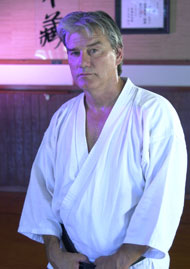
Tom Muzila • 4th Dan black belt under Tsutomu Ohshima (SKA) and exponent of extreme marathon Budo discipline.
Is marathon training really practical for normal practitioners? What is its true underlying purpose?
Definitely. But students must understand the value of it before undertaking it. If someone is forced into it, they might mechanically execute 10,000 punches just going through the motions. A focused student doing 100 punches with the right mental state will gain infinitely more.
The real point of marathon training is not brute endurance, but concentration. In standard practice, people let stray thoughts flood their heads while punching and blocking. They let external stimuli rule them. In marathon training, the aim is to hold one laser point of focus: to prevent a single gap or lapse in your concentration across thousands of repetitions.
Every single technique must be executed as if it were your absolute best—like the last technique you will ever perform before you die.
How do you handle the psychological element of fear—fear of injury, failure, or physical collapse?
First, consciously acknowledge that the fear exists. Identify where it came from. Examine what benefits you will reap by letting it go, and visualize what expansive world will open up once that barrier is removed.
Do not run from fear, wallow in it, or put on a false macho display. Get close to your fear, recognize it, but do not let it overwhelm your emotions. Regulate your breathing immediately to calm the mind. Face it directly alongside an experienced teacher who has already walked through that fire and demonstrated that overcoming it is humanly possible.
How does Zen philosophy resolve anxiety when facing a formidable opponent?
This is where Zen non-attachment becomes decisive. As soon as your mind attaches to your opponent's name, reputation, or the memory of him defeating you previously, your mind becomes imprisoned.
In the immediate here-and-now, he has done nothing yet. He is simply another opponent. Shut down the inner noise of anxious thoughts by centering upon your breath. When the mind remains unattached, you perceive reality clearly as it unfolds.
Along with fear, intense training brings pain. How do you distinguish between constructive pain and destructive injury?
There are two types: positive pain and negative pain. Forcing a stretch blindly until you tear muscle fibers is senseless. Facing pain requires progressive, seasoned adaptation under the watchful eye of an instructor.
As physical fatigue mounts across hours of training, the body naturally discards superfluous tension. Shoulder tension drops away, breathing becomes economical, and excess physical power is replaced by deep, refined mental clarity.
"The real point of marathon training is not grunt endurance, but absolute concentration — where every single technique must be executed as your very best, like the last one you will ever perform before you die."
