MONDO: Dialogue with Zen Master Taisen Deshimaru on Breathing, Hara & Kiai
A profound Zen dialogue (Mondo) with Master Taisen Deshimaru on the lower abdomen (hara), the explosive unification of energy in the kiai, deep exhalation, and the unity of Zen meditation and traditional Budo
Archival Document • The Shotokai Encyclopedia Archive
MONDO: The Zen Way to the Martial Arts
A Mondo (問答, literally "question and answer") is the classic Zen method of rapid, direct inquiry between disciples and a master. In this exchange, Master Taisen Deshimaru cuts through intellectual theories to reveal how respiratory control, lower abdominal awareness (hara), and ego-free action form the living foundation of traditional martial practice.
The Mondo
What is the single most important thing in the martial arts?
Breathing.
What condition are you in below the navel? I do not mean your reproductive organs! I mean the hara, three finger-widths beneath the navel.
The only way to awaken the true power of the hara—to concentrate and gather all of your vital energy there—is through right, conscious respiration.
Can you speak to us about the Kiai, the shout used in karate and kendo? In our dojo we are made to shout constantly in violent repetitions...
The penetrating vibrations of an authentic kiai momentarily paralyze the adversary. It is directly comparable to the kwatz shout that Rinzai Zen masters use to shock their disciples awake.
In my view, there is absolutely no purpose in repeating it mechanically over and over. Once is enough—but once, truly.
Expel your shout with everything that you are, surging out from the hara—the lower abdomen which the Japanese call kikai (the ocean of energy). To execute this properly you must master Zen breathing, which is identical to Budo: an extended, deep exhalation. It is precisely at the final culmination of the exhalation that your internal energy reaches its zenith.
The kiai is that same exhalation fused with sound, springing spontaneously from the roots of the body. The word itself is composed of Ki (universal energy) and Ai (union): the total convergence of all energy. One cry, one instant encompassing the cosmos!
[At this point, Deshimaru Roshi suddenly released a tremendous, room-shaking roar; the assembly was frozen in shock, before erupting in joyful laughter.]
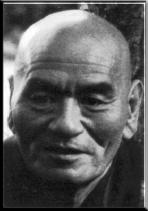
Zen Master Taisen Deshimaru (1914–1982) • Bringing the living unity of Soto Zen and traditional Budo to the Western world.
Why does most shouting heard in modern dojos sound so empty, artificial, and devoid of real Ki?
Because they have never learned how to breathe! No one has taught them.
People shout or chant merely to exhibit their own personalities—they produce theatrical vocal decoration. It is not raw volume that creates true power. The sound must erupt from the hara, never from the throat. Observe how a cat meows or how a tiger roars: that is a natural kiai.
Train your breathing continuously; but never try to grasp at some magical power. In the way of Budo, as in the way of Zen, you must practice without any object or desire for profit (mushotoku). Most people are consumed by wanting to get something; they desire to have instead of simply to be.
How does correct respiration operate in Zazen, and how does it directly connect to combat?
Breathing cannot be established until physical posture is immovably aligned: straight spine, stretched neck, thumbs touching lightly in a horizontal line, neither mountain nor valley.
There is a brief, natural inhalation, followed by an extremely deep, lengthened exhalation that presses down upon the abdomen below the navel. One exhalation can be extended for two, three, even five minutes.
In martial combat: one is powerful while breathing out, and deeply vulnerable while breathing in. You must launch your decisive move at the moment your opponent begins to inhale. At the end of the inhalation lies the point of maximum weakness; at the culmination of the exhalation, your feet grip the earth like roots, and you are unshakable like a tiger.
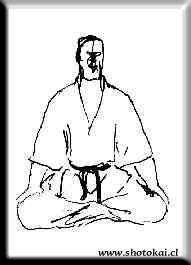
The posture of Zazen • Unyielding spinal alignment, relaxed shoulders, and respiration sinking into the hara.
Can intensive practice of Kata replace the seated meditation of Zazen?
You cannot substitute the stillness of seated meditation with active movement exercises. But Zazen infuses an entirely new dimension into your Kata.
The essence of kata does not reside in the external choreography itself, but in the internal attitude brought to it. You must not think: "This kata must be performed like this or that." Instead, train the bodymind to generate, in every single instant, one complete, unified gesture mobilizing the whole Ki of the universe.
And above all: cultivate Zanshin. Zanshin is the mind that remains tranquil and alert without being attached to anything. In Zen, as in traditional Budo, the goal is total, authentic presence across every second of daily existence.
"The word kiai is composed of ki (universal energy) and ai (union) — the total union of all energy. In the way of Budo as in the way of Zen, you must practice without desire for profit. Most people always want to have; the martial way teaches us simply to be."
